Do you know what are the most prevalent materials used to build the blades of kitchen knives? What are the differences between them? For example, what are the advantages of carbon-steel blades over stainless steel blades? In this article, we are planning to see the features of the most popular blade materials used in this regard.
Although there are numerous applications for knives these days, kitchen knives still have the highest amount of applicability as all of us use them in our kitchens. Everybody has been at least once on the road to choose between different knife blades on the market, wondering which is the best option for their specific usage.
Whether you are intending to chop vegetables, slice cheese, or tear apart meat, you are inevitably in need of a kitchen knife. That’s why you undoubtedly should have the right knife in your kitchen. As a result, it is a wise piece of advice to know the materials and their features. It might be agitating at first, but let us go ahead and see which materials are widely used in this industry and what their properties are.
Most Used Kitchen Knives Blade Materials
Kitchen knives are typically made of myriad different materials. The most widespread materials used in this regard are stainless steel and carbon steel. Although the main controversial debate is over which one of these two materials outperforms the other, there are other known materials used to manufacture kitchen knife blades too. Ceramic and titanium are also widely used to build kitchen knives.
It is a little too complicated to distinguish which material is the best one in this case. Speaking of stainless steel, it is good to know that there is no “truly stainless” steel out there because any kind of steel will eventually rust under certain conditions.
In the following sections, we will thoroughly look at various materials used to build kitchen knives.
Stainless Steel
Although the term “stainless steel” is widespread among buyers, as we mentioned earlier, this material is also prone to rusting under specific conditions. Maybe it is better to know steel as only “resistant” to stain. However, everyone knows it by this name and we are using it as well.
If a steel is called stainless, it certainly needs to contain at least 10.5% or more chromium (Cr). Chromium helps the steel remain resistant to corrosion, wear, and decay. Otherwise, the quality of the stainless steel kitchen knife is under question.
There are different types of steel used in kitchen knives. Some more common ones are VG-10, 420HC, and 440C.
The beneficial point in the case of using stainless steel kitchen knives is that it takes a longer time for steel to rust. However, steel blades having more quantities of carbon may rust more quickly.
In kitchens, knives are always in proximity to the water coming from food. This expedites the process of rusting and getting stains. Despite that, stainless steel blades need less maintenance as the rate at which they rust is very slow. Although stainless steel knives outperform all other materials in the field of durability, they suffer in performance. It is different from one steel to another, but in general, the edges of stainless steel blades will not last very long.
Carbon Steel
Steels that are not stainless and have almost 1% carbon content, are known as carbon steels. Instead of using chromium, carbon steel blades typically come with other alloys such as manganese and vanadium.
The best characteristic of carbon steel blades is that they are offered at reasonable prices and are easily sharpened. Carbon steel can hold its edges well.
On the other hand, carbon steel is not resistant to stains and even if you take care of it very well, they undergo the process of oxidation. In other words, the color and texture of carbon steel will eventually change over time and there is no way to avoid it.
High-Carbon Stainless Steel
As the name suggests, this material is another type of stainless steel that contains higher amounts of carbon than conventional steel. In other words, high-carbon stainless steel is an alloy with higher grades.
High-carbon stainless steels indeed offer the best features of both stainless steel and carbon steel simultaneously. This means that not only does this material offer high strength, edge retention, and cutting capabilities, but it also stays resistant to stains and rust. The truth is that there is no specific standard defining what high-carbon steel is. As a result, you may sometimes see some companies claim they are offering high-carbon kitchen knives, while the carbon content used to build their knives is hardly ever over 1%. Therefore, you need to dig further through what you are purchasing to find out if the product is truly high-carbon stainless steel.
Additionally, there is one thing else you must consider cautiously: high-carbon stainless steel kitchen knives are more expensive than carbon steel and stainless steel.
Ceramic
One other material that is widely employed to build kitchen knives is ceramic. Zirconium powder is heated in these knives to increase their strength. Then, the blades are strongly sharpened to offer the keenest edges possible. Ceramic edges seldom need to be sharpened again. Moreover, these kitchen knives are perfect for cutting fruits and vegetables; however, they might show weakness when cutting meat and frozen foods.
Ceramic is extremely durable in the stiffest conditions, and this is maybe the best feature of this material. Ceramic blades rarely rust, and even if you use them to cut your acidic foods, they are scarcely affected. In addition to that, ceramic is extremely lightweight despite being durable. Once you sharpen a ceramic blade, the razor-shape edge you find is seldom in need of sharpening again.
Despite all the advancements in technology that have made ceramic blades even stronger and more durable than before, they are yet more brittle than steel. Although they can maintain their sharp edges much longer than steels, they might need professionals for sharpening once they are dull.
Damascus Steel
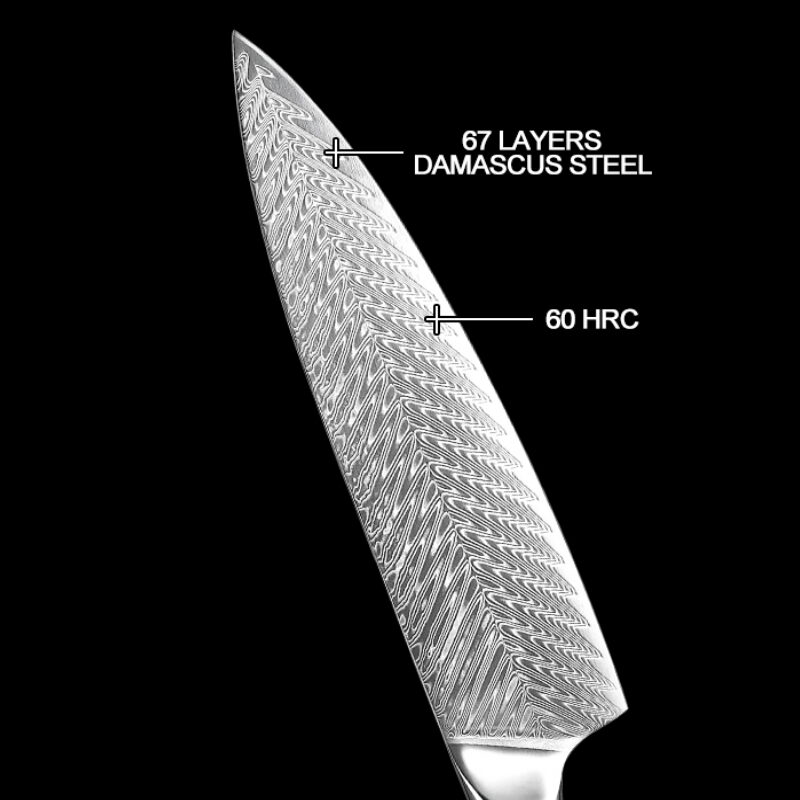
Damascus steel is mostly known for its wavy, beautiful pattern on its surface. It is a sharp, strong, and reliable steel that is highly valued due to its hardness, flexibility, and sharpness. Damascus is primarily made by forging a mixture of iron and steel followed by continuous heating.
The history and one-of-a-kind appearance of Damascus steel is what makes it adorable to chefs as well as collectors. Although the wavy or swirly design of this material may catch your eyes, the price tag may not. Damascus is, just like stainless steel, resistant to corrosion. Also in the case of durability, Damascus is as durable as stainless steel. It can retain its edges to a high extent.
Titanium
Titanium is much less used to build kitchen knives. Yet, it is a good alternative to stainless steel and carbon steel blades. Titanium is a softer material than others and is scarcely used in this field.
Titanium, in its nature, does not chemically react with the substances in the foods. This is probably the biggest advantage of titanium over its rivals. Furthermore, it is more flexible than steel. Speaking of price, titanium is more expensive than its opponents. It is considered to be a special material that is not even well optimized for kitchen equipment.
Other Materials
The materials mentioned above are not the only ones used to manufacture kitchen knives. There are also less common materials used in this industry. One of them is talonite. This material is roughly thick, without having anything better than the more common materials.
Another material is plastic. Plastic blades are not sharp at all and are usually built for specific purposes. What is good about plastic knives is that they are safe, disposable, and do not get discolored.